Posts

Showing posts with the label Anxiety

Breaking the Stigma on Mental Illness

by Angela Fernandez, School Psychologist Although Mental Health Awareness Month has come to an end, the need for awareness and acceptance of mental illness has not. I encourage you to read on to learn more about mental illness, stigma, and steps you can take to help end the stigma associated with mental illness.  Let’s first talk about what it means to have a mental illness. According to the American Psychiatric Association (2021), a mental illness is a condition defined by a combination of changes in thought patterns, emotions, and behavior that cause distress and/or dysfunction in social, family, and/or school/work activities.  But I’m not aware of anyone who has a mental illness, so it must not be THAT common, right? Wrong! Mental illnesses are very common. So far in 2021, 19% of adults in the United States of America are experiencing a mental illness. That is over 47 million Americans (Mental Health America, Substance Abuse and Mental Health Data Archive, 2021)! Children ...

Journaling: A Personal Experience

Image
  I have always been an anxious person. I have the tendency to overanalyze, overthink, and obsess over every little thing. After the pandemic hit, my anxious tendencies shifted to obsessing about safety. Do I have Covid? Is that surface I just touched contaminated with the virus? Will my family be okay? It didn’t take long for these thoughts to totally consume and control my mind. The majority of my thoughts surrounded Covid and my family’s safety. The constant worry was exhausting. How could I be a school psychologist and not have control over these thoughts? How can I help others when I cannot even control my own worry?  After some gentle prompting from someone else in the helping field, I started to journal. I found that I was instinctively using a technique called stream of consciousness journaling . Stream of consciousness journaling is a writing technique used to narrate and keep track of thoughts. When I cannot shift my obsessive thoughts to something positive, I open m...

The Grief of Adjusting to “The New Normal”

Image
Way back in the spring, when Covid-19 began, we were all in a state of shock. What do you mean my children are learning at home? What do you mean my job is in the dining room instead of my office? What do you mean I can't go out to dinner or to the movies? At that time, I read an article called “ That Discomfort You're Feeling is Grief” (published March 23, 2020) in the Harvard Business Review. I recently reread this article and it still resonates with me. The beginning of the school year has always been full of  joy and anticipation,as well as a healthy amount of anxiety. This year, I don't think I'm alone in feeling an unusually high level of anxiety. This year is not starting as any of us would like it to. I have more questions than we have answers. When will my kids go back to school? When will I go to work? How do I balance all of this? When will the virus let up and let me get on with my ordinary life? So many questions!  In this article, ( That Discomfort You...

May is Mental Health Awareness Month

Image
As we launch into May during a global pandemic, it is more important than ever to check on your people. The American Foundation for Suicide Prevention encourages us to have a #RealConvo with the people in our lives. Although that may look different this year than it has in the past, they offer tools, resources and creative ways to do this. They also a provide a calendar of activities happening throughout the month. Here are some quick tips for having a #RealConvo about mental health: When someone is struggling, just listen. Let the other person share at their own speed. Don't pass judgement or offer advice; just be there. We all experience mental health differently, and that's okay. Check back in and offer to connect them with help if they need it.

Using Social Stories to Explain the “New Normal”

This feels like a different world that we are living in recently!  Stay at home orders, distance learning, social distancing, mask wearing, etc. are different for all of us, and can be particularly challenging for young children or kids with autism. Children with autism often struggles with changes in routine, or things that are unexpected.  Social stories can help kids be prepared for things that could be different or new experiences  A social story is described by Carol Gray, creator of Social Stories, as a “social learning tool that supports that safe and meaningful exchange of information between parents, professionals and people with autism of all ages.”  More simply put, for many children, a situation that is difficult to understand can be made more clear with the help of a simple story, with pictures and told in the first person.   In a typical situation, for example, a child might need help understanding how he or she needs to behave in the cafete...

"Box Breathing" Strategy for Anxiety

Having trouble with your anxiety? If so, you are certainly not alone. This situation is unsettling, at best. Our brains are wired towards what’s called the fight or flight response. When our brain perceives that we are in danger of some sort, we either want to run away from the perceived danger or fight with it. Neither of those strategies is an option, which of course makes us anxious. Often, when we are anxious, we breathe very shallowly, or may even hold our breath without realizing it. Making a conscious effort to breathe more deeply in a controlled way is one way that we can help to calm our nerves and calm that fear response in our brains. There is a simple technique, called box breathing, that can help to ease our anxiety. First, either imagine a square in your mind or draw a square on a piece of paper. Now, time yourself for 4 seconds across each side of the square. 4 seconds across the top to the right, breathe in. 4 seconds down the side of the square – hold your breat...

Finding a Distance-Learning Balance: Mental Health and Academics

Image
There's so much information coming at us from so many different directions right now.  Not only are we trying to keep up with news about this pandemic and how to keep our families safe, but we're experiencing disruptions to our social lives and our jobs.  The cherry on top of this COVID-19 sundae is that many parents are now being asked to step into what is, for many, a brand new role: distance learning facilitator.  (Make sure you put that on your resumes from now on! 😉)  Parents, students and educators are ALL scrambling to learn new routines and new technologies with very little - if any - warning, guidance or training. Recently, the Twitter feed for @teachergoals.org  posted something that really resonated.  When I feel myself getting overwhelmed by the "tsunami of stuff" coming at from me all directions, I revisit this tweet : Since this blog is written by a bunch of psychologists, it's probably no surprise that student mental health is our pas...

Will Suicides Increase Because of COVID-19?

Image
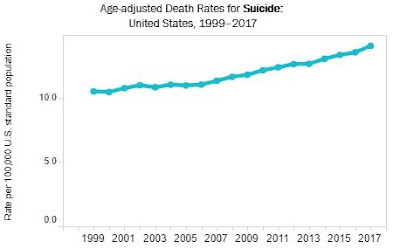
Recently, we have been hearing concerns about whether the suicide rate may increase as a result of the COVID-19 pandemic.  Right now, anxieties are already elevated because of this novel situation.  We all know that - more than ever before - our focus must remain on facts, not fear.  In order to help our readers consider that very complex question, let's start by reviewing facts we know about suicide. In this blog post from 2019 , we talked about the World Health Organization's latest data on suicide, which indicated that between 2010 and 2016, the global suicide rate decreased by 9.8%.  However, the WHO also found that the only region to see an increase was the Americas.  According to the  CDC's surveillance data ,  suicide is currently the 10th leading cause of death in the United States and   suicide rates have shown a steady pattern of increase in the United States: The CDC also provided a list of risk factors or characteristics ass...

Got Anxiety? Got stress? Help is out there ( and you don’t even have to leave your house to find it).

Got anxiety? Got stress? At this point, I’m pretty sure it’s safe to say that we do. In these “unprecedented times” it sometimes hard to know how to cope with all of the changes that have happened so quickly, and in knowing how to cope with our new normal. As parents, it is important for us to know how to facilitate good mental health, for ourselves, and also for our children. We are important too, and if we aren’t healthy, how can we care for them? For people who are looking for support, NAMI (National Alliance for Mental Illness) has developed a resource guide to helps to address many of the questions that people may have as they cope with the current situation. They are also available by phone to address questions that might not be answered by the guide. Topics include how to cope with anxiety, how to cope with feelings of loneliness and isolation while sheltering in place, or quarantined, how to help people with mental illness or even what assistance programs are available for ...

Got Coronavirus Anxiety?

Image
You're not alone if you're feeling nervous or stressed about COVID-19, also known as the Coronavirus. The Governor of North Carolina declared a State of Emergency yesterday. You can't turn on the television or radio without hearing about Coronavirus. Visiting the hand sanitizer or disinfecting wipes section of your local grocery store may reveal lots of empty shelves. Winston-Salem/Forsyth County Schools has added an "Information on Coronavirus" page to our District website. You'll find resources in both Spanish and English to help parents talk with their children about Coronavirus. There are also links to trusted websites and guidelines for prevention. In addition to those resources, NPR recently posted " A Comic Exploring the New Coronavirus ." Here is an excerpt from that comic: This kid-friendly explanation of the Coronavirus became so popular that NPR posted an updated article sharing that it had been translated into several other l...

End of Year Stress...for students AND teachers

We haven't posted in a while.  Why???  School Psychologists experience stress too, especially this time of year! It seems like everyone, staff and students alike, are running around trying to get everything done before the end of school. There is the anxiety over those end of year tests.  Some students are also concerned about being promoted to the next grade.  Teachers often experience similar worries as they try to make tough decisions about students.  Most high school students feel the pressure of projects or exams while some worry about whether they will even graduate. Outside of school, the stress caused by things going on at home can generate even more anxiety for some children. As summer approaches, they might worry about where their next meal will come from or whether they will be safe at home.  For these children, schools provide the comfort, safety, and predictability they don't have during the summer months. This article from  Edutopia ...

The Fidget Frenzy!

Image
In my house, we are the proud owners of three fidgets.  We have two spinners and one cube.  If you've been under a rock and haven't heard about them, this article from Live Science  explains some of the science behind their popularity.  A few months ago, my kids started telling me they needed one in order to reduce anxiety and stay focused. Since the popularity of fidgets has exploded, I've heard mixed reviews from teachers and some schools have even banned them.  In this article from  U.S. News & World Report , two occupational therapists weigh in on the debate with different opinions. Fidgets have actually been around for years and have certainly supported the needs of some special needs children. What is your opinion?  We would love for you to weigh in on this debate!

Help for anxious teens and kids.....

As anyone who has ever had anxiety knows, it is no joke.  Although there certainly are times when being anxious can be helpful, such as when you are running from a bear, or need to start studying for that test you have tomorrow, at many times it is just plain uncomfortable and not very constructive.  And as we all know, people telling you to relax doesn't help at all.  If you knew how, you would do it, wouldn't you?  There are, however, excellent resources out there to help teens and younger kids to learn about and cope with their anxiety in helpful ways.  For any parent or school personnel that are trying to help someone cope with their anxiety, these websites may be excellent resources.   Resources for families Resources for teens Resources for kids and families

Mental Health App for Adolescents and Young Adults

I do not consider myself the most tech savvy person, but I do try and stay informed on the latest apps, especially when they are designed for young people. Yesterday a student at my high school introduced me to Buddy Booster.  I was so intrigued that I spent some time learning more about it and reading the user reviews.  Buddy Booster was designed for youth and young adults to help them manage their wellness and overall mental health.  Users choose a character, or buddy, that falls asleep everyday and the user has to "wake" it up by interacting with it.  Users start by identifying how they feel each day. Based on that information, users must complete activities to get their buddy going.  If they are having a day of crisis, the app provides coping strategies as well as emergency contact information.  All of this information has to be entered by the user (in the settings) so it is designed to meet his or her particular needs. There are more features available...

Test Preparation Strategies

Image
We mentioned in a previous blog that we would be posting strategies to help students prepare for the end of year tests.  That preparation should include not only recommendations for how to study but also ideas for how to manage the anxiety that might accompany the tests.  This page from the National Education Association includes all kinds of links to websites for test taking tips.  They have links for students, parents and educators in grades K-12.  To learn more, visit  http://www.nea.org/tools/lessons/Test-Prep-Review-Strategies.html

Test Taking Stress

Are your students worried about the upcoming End of Grade tests or exams?  There are lots of great suggestions for how to prepare for them (be looking for another post about that), but here are some ideas from PBSKids for how to manage the stress once the test actually begins.  To see them all, visit  http://pbskids.org/itsmylife/school/teststress/article10.html

Tips for De-escalating Interactions with Anxious or Defiant Students from Mind/Shift

This is the time of year when it seems like behavior problems are most prevalent.  Maybe it is the stress of end of grade tests or just the pressure of finishing up the year.  It could be that teachers and other school staff are dealing with their own end of the year stressors.  Regardless of the reasons, it is helpful to understand the function of behaviors and know some tips for de-escalating them.  This article from Mind/Shift notes that a students' negative behavior is almost always a form of communication for them.  When you know what they are communicating, it is easier to figure out how to reduce the behavior.  To learn more about these 20 recommended tips, visit  http://ww2.kqed.org/mindshift/2016/04/21/20-tips-to-help-de-escalate-interactions-with-anxious-or-defiant-students/

InfoAboutKids.org- Check it Out

A recent post on the NASP membership exchange caught my eye for additional information and resources. The website is  http://infoaboutkids.org/  .  This website was recently recommended by APA Division 16 for School Psychologists. The topics presented are organized under the following headings: Home, Body, Mind, Emotions (which includes trauma), relationships, general resources and blog. This is a great website with all types of information to support children's physical, social and mental health needs. The information and resources are written for parents, educators and mental health professionals. You can choose a language for the website, so it is a good resource for families who speak other languages besides English. There is so much information available under each section, hopefully you can find it useful for our families and students K-12!

CDC Releases New Data on Number of Children with Disabilities

The Centers for Disease Control (CDC) has released information from the 2011-2012 National Survey of Children’s Health on more than 35,000 children aged 2 to 8.  As part of this survey, parents were asked "if they had ever been told by a doctor or health care provider that their child had attention deficit hyperactivity disorder, depression, anxiety problems, behavioral problems such as oppositional defiant disorder or conduct disorder, Tourette syndrome, autism spectrum disorder, learning disability, intellectual disability, developmental delay, or speech or other language problems."  While the results varied across different states, the overall rate for disabilities was 15.4%, or about 1 in 7 children .  North Carolina's rate was right in line with the national average for the overall rate, at 15.6%. This data is certainly meaningful when you consider the significant amount of additional resources and support that these children and their families may need throughout ...

Childhood Anxiety resource: WorryWiseKids.org

As the common core and end of the year testing season approaches us (although it never seems like it left), we may see an increase in children with anxiety. Sometimes kids that are seemingly holding it together, the added pressure from teachers, parents or peers can set them over.   Worry Wise Kids  offers a great deal of information for parents, teachers and others who work with students who face anxiety. It provides information about what is typical and to be expected along with Red Flags for when a child may require additional support. Anxiety in childhood is the most prevalent childhood mental health disorder, but it is also the most treatable. Check out their website for more information and ways to help and advise our parents and teachers on how to access help for our students. http://www.worrywisekids.org/