Posts

Showing posts with the label Bullying

Standing Together Against Bullying: A Message from Psychological Services

Image
October is National Bullying Prevention Month , a time when schools and communities across the country come together to raise awareness and promote kindness, inclusion, and safety for all students. As your school psychologists, we want to take this opportunity to open up a conversation about bullying—what it looks like, how it affects students, and what we can all do to help prevent it. What Is Bullying? Bullying is more than just conflict or “kids being kids.” It’s unwanted, aggressive behavior that involves a real or perceived power imbalance. It can take many forms: Physical (e.g., hitting, pushing) Verbal (e.g., name-calling, teasing) Social (e.g., spreading rumors, exclusion) Cyberbullying (e.g., harmful messages or posts online) What makes bullying especially harmful is that it’s repeated over time, and it can leave lasting effects on a student’s mental, emotional, and even physical well-being. The Impact of Bullying As school psychologists, we see firs...

Day of Unity - October 16, 2024

Image
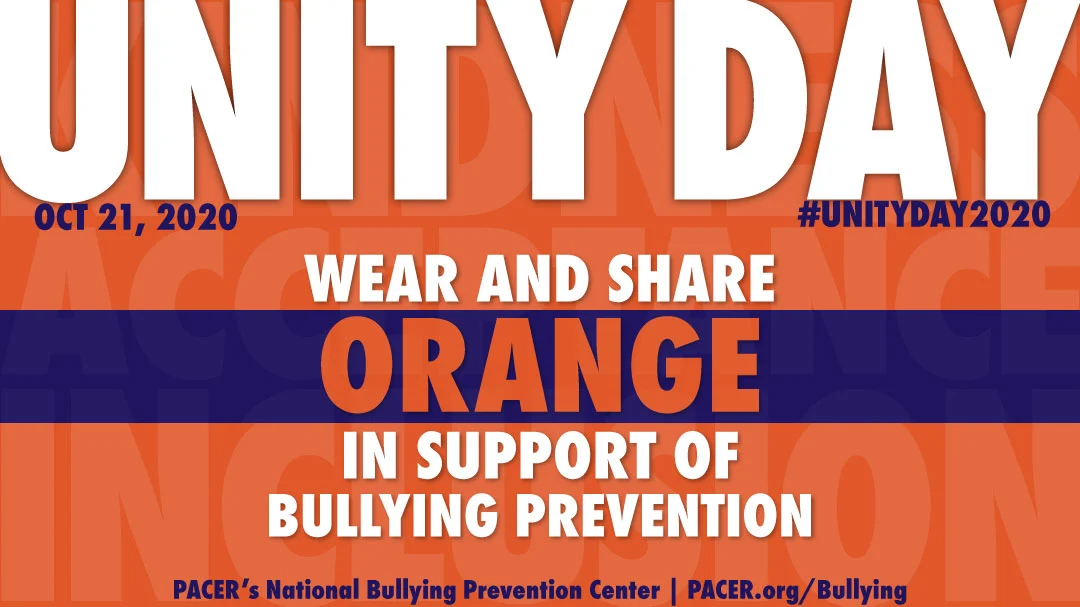
Unity Day is the signature event of National Bullying Prevention Month. The key message of this month, and this day, is to unite for kindness, courage, and inclusion, to prevent students from being bullied. You can support this event by wearing the color orange. Orange is a color commonly identified with the month and the autumn season. It is also a color that is associated with safety and visibility. It is a color described as warm and inviting, and its vibrancy makes an impactful statement. Wear orange on Wednesday, October 16, 2024, to show your support for bullying prevention.

October is National Bullying Prevention Month

Image
October was first declared National Bullying Prevention Month in 2006 to prevent childhood bullying and promote kindness, acceptance, and inclusion.    The US Department of Health and Human Services defines bullying as unwanted, aggressive behavior among school-aged children that involves a real or perceived power imbalance. The behavior is repeated or has the potential to be repeated, over time. Bullying can be verbal, social, physical, or cyber and can lead to school avoidance, loss of self-esteem, increased anxiety, and depression.  The National Child Traumatic Stress Network reports that 1 in 5 high school students are bullied in the United States. The NCTSN also provides facts on the relationship between trauma and bullying indicating the importance of addressing both bullying and trauma.   October 2, 2023, is World Day of Bullying Prevention!  Stomp Out Bullying encourages us to join in solidarity to stop bullying and cyberbullying by wearing blue th...

Unity Day 2020

Image
Today is #unityday2020 . According to Pacer.org , 1 out of every 5 children are bullied. Research indicates that bullying prevention can be successful when students, parents, educators, and community members are involved.  Students - if you see bullying intervene and tell a trusted adult. If you are being bullied, talk to your parents/guardians and tell a trusted adult at school. Parents - learn what bullying is and how to recognize the warning signs. If you believe that your child is a victim of bullying, listen to your child and try to find out what is happening. Educators - work to establish an inclusive and safe learning environment. Respond when bullying happens.  Community Members - learn what bullying is and what it isn't. Learn how to respond.  To learn more about bullying prevention, please visit:  https://www.stopbullying.gov/prevention/on-the-spot https://www.stopbullying.gov/resources/what-you-can-do#parents Wear and share ORANGE   (with us) to show...

Cyberbullying & Remote Learning

The rapid growth of technology in our society has led to a new type of bullying...cyberbullying.  A surprisingly high number of students report being a victim of this type of bullying. According to a 2019 report from the CDC , cyberbullying among public school students is highest for middle school at 33%, followed by high school at 30%. Even 5% of elementary students report having been cyberbullied. Due to the impact of Covid-19 in 2020, many schools have had to switch to remote or distance learning. This situation has increased opportunities for cyberbullying since most learning occurs in virtual classrooms and other online platforms.   Children and teenagers are often more tech-savvy than their parents/guardians which can make it challenging to monitor their online behavior. Like other forms of bullying, cyberbullying can cause significant stress and emotional problems for the child, so it is important for parents/guardians to know the different ways children and teenag...

Be an Upstander! National Bullying Prevention Month

Do you know what an Upstander is?  During a bullying situation, there are different roles youth play.  There is the child who is engaging in the bullying behavior and the child who is being bullied.  But there is often a bystander as well, a child who witnesses the bullying.  When a child sees someone being bullying, it can be upsetting, even if they are witnessing it online.  It is important to equip children with the tools they need to shift from being a Bystander to an Upstander.  An Upstander also witnesses the bullying but then intervenes or speaks up in order to stop that behavior.  We really like this article from  stopbullying.gov  because it gives youth practical tips for becoming an Upstander in those situations.  At home and school, it is important to talk with children about what they can do when they witness bullying. 

Our Unique Role in Bully Prevention

As we all know, October is National Bullying Prevention Month.  Each year, we talk about this topic with our students and discuss ways they can help prevent bullying.  As teachers and support staff, most of us view our role as supporting positive behaviors in students.  But have you ever stopped to think about what each one of us can do with our own actions to foster an environment of kindness in our schools?  When I came across this article from weareteachers.com, I started to think about the powerful role models we are to our students and what a tremendous impact we have on their attitudes and actions. This article gives 49 simple ideas for creating a positive environment in our schools. 49 Ways to Create a Tidal Wave of Kindness in Schools

New York Town Creates Bullying Law

Since October is National Bullying Prevention Month, here's a situation to consider.  A town in New York state, North Tonawanda, has created an anti-bullying law. The new law went into  effect on October 1 st .   The law requires parents of minors found bullying other minors to pay a fine. In addition, parents may face possible jail time. The North Tonawanda City Council passed the law in hopes that it will put a stop to bullying. What do you think about the new law? Does this go too far?  To learn more about the North Tonawanda bullying law, click here:   NY Bullying Law

How to Protect Girls from Relational Aggression

Are you asking what relational aggression is and what does it have to do with girls?  Relational aggression is just a fancy name for 'mean girls' behavior. As a school psychologist, I've been familiar with this behavior for years.  I've seen it in action and worked with girls on both the giving and receiving end of it.  But as the parent of a middle school girl, I have seen the pain it can cause firsthand.  This article from the SMC Education Blog provides information on why relational aggression happens, how it can be managed, and how parents can help.  To learn more, visit Girls and Their Frenemies    

stop bullying.gov

October is National Bullying Prevention Month. Last week, as a school system, we showed our support and advocacy for bullied students during Unity Day.  Many people in our system wore orange to show our solidarity to STAND UP, STEP UP with our students against bullying.  According to an article posted on stopbullying.gov, 'bullying is linked to many negative outcomes including impacts on mental health, substance use, and suicide.  It in important to talk to kids to determine whether bullying - or something else - is a concern."  Although parents, teachers, and other students want to help, it's hard sometimes to know where to begin.  Stopbullying.gov  has valuable information about what can be done to help, as well as information about cyber-bullying, risk factors, prevention, and the best way to respond if you do have a concern. .

Video Series on Empathy from Class Dojo

Many teachers are using Class Dojo to help support and manage positive behaviors in the classroom setting.  Did you know Class Dojo also offers videos to support character traits such as perseverance, growth mindset, and empathy.  Although the series on perseverance has not been released yet (look for it in November), the videos on empathy were released at the beginning of October to coincide with National Bullying Prevention Month.  They can be watched at home and at school so that parents and teachers can work together to help children understand how to accept others and put themselves in their shoes.  The videos feature the Class Dojo monsters that kids know from class.  To go along with the videos, there are a set of discussion questions and projects so that parents and teachers can reinforce what the children have learned.  The Class Dojo blog describes empathy as a foundation skill necessary for learning to act ethically, build strong relationships, a...

Manners Vs. Empathy and The Eddie Haskell Effect

This article published by NPR today really hit home with me.  It describes children who are kind but not necessarily helpful or thoughtful.  You might wonder how this is possible.  As described in the article, some children who have great manners are perceived as being kind even when they lack empathy.  In some cases, I've observed those children can actually be engaging in bullying behavior.  My friends and I have been calling it the Eddie Haskell Effect for years.  Do you remember Eddie from Leave It To Beaver (I'm dating myself)? He was especially polite to Beaver's parents but a real bully to Beaver.  When I was writing this blog tonight, I googled Eddie Haskell and discovered we were not the first ones to have seen this effect.  There is even an article from Psychology Today which describes it ( Eddie Haskell Effect ).  Since we are in National Bullying Prevention Month, it seems appropriate to have conversations about how to not only te...

6th Annual Stand Up Step Up Walk/Rally Against Bullying

Image
Join the Winston-Salem/Forsyth County Schools and its community partners for the 6th Annual Stand Up Step Up Walk/Rally Against Bullying on Saturday, October 8th at 8:00 a.m. a the BB&T Ballpark.  This is an opportunity for us to unite against bullying and show our children that we support and care about them. In addition to the walk itself, it promises to be a great morning with student performances and breakout sessions for middle and high school students.  

October is National Bullying Prevention Month

Image
Throughout the month of October, we will be posting information on how to prevent bullying and the steps we can take to stop it.  In this informative video from stopbullying.gov, we find out about the role of a "bystander" and how this person can actually reinforce bullying behaviors.  They also provide strategies for how to teach children to be "more than a bystander."  To learn more, visit  https://www.stopbullying.gov/respond/be-more-than-a-bystander/index.html

InfoAboutKids.org- Check it Out

A recent post on the NASP membership exchange caught my eye for additional information and resources. The website is  http://infoaboutkids.org/  .  This website was recently recommended by APA Division 16 for School Psychologists. The topics presented are organized under the following headings: Home, Body, Mind, Emotions (which includes trauma), relationships, general resources and blog. This is a great website with all types of information to support children's physical, social and mental health needs. The information and resources are written for parents, educators and mental health professionals. You can choose a language for the website, so it is a good resource for families who speak other languages besides English. There is so much information available under each section, hopefully you can find it useful for our families and students K-12!

The Buddy Bench

Have you heard about The Buddy Bench?  As we continue efforts to promote acceptance and foster a safe and respectful environment for children, this idea gives students of all ages a hands-on way to do that when they are on the playground.  The idea fits nicely with all of our anti-bullying efforts.  The concept, started by an 8-year-old named Christian, is pretty simple.  Students who feel insecure or nervous about joining in with playground activities and games are encouraged to sit on the buddy bench as a signal to other students that they would like to be included but are afraid to ask.  It can be a place to meet new friends and play with old friends.  This article from the Huffington Post provides a great explanation of why this is such a special idea. http://www.huffingtonpost.com/entry/buddy-bench-students-pittsburgh_us_5655e132e4b079b28189dcd2 To hear more about Christian's story and watch a video he created, visit: http://buddybench.org/

The Role of "Influential" Kids in Bully Prevention

This article by the National Association of Educators refers to a recent study conducted by Princeton University.  The study identifies sets of students, referred to as "influential" kids, that may hold the key to anti-bullying efforts in schools. The results of this 2012-13 study saw promising results with a 30% drop in student conflicts that year.  To learn more about this study, visit: http://neatoday.org/2016/02/03/influential-kids-stop-bullying/ A recent article written by the Winston-Salem Journal focuses on bullying solutions as well as current anti-bullying efforts by the WS/FCS.  To read that article, visit: http://www.journalnow.com/news/local/online-or-in-person-solution-for-bullying-is-the-same/article_c9e562ed-dca2-5f72-b489-6ab000bbf8a7.html Here is a link to other blogs we have posted on the topic of bullying and anti-bullying efforts: http://schoolpsychws.blogspot.com/search/label/bullying

Cyber Bullying

The rapid growth of technology in our society has led to a new type of bullying...cyber bullying.  A surprisingly high number of students report being a victim of this type of bullying.  It can be difficult to determine when it is happening to your child because it can take place through email or texts, in chats rooms, and on numerous social media sites.  Children are often more tech-savvy than their parents which can make it even more challenging to keep track of when this type of behavior is occurring.  Just like with other forms of bullying, cyber bullying can cause significant stress and emotional problems for the child.  This presentation from Mayorlaw gives current statistics regarding the prevalence of cyber bullying and the impact it could have on your child. http://mayorlaw.com/cyberbullying/ Here are some other blogs we have posted on the topic of bullying. http://schoolpsychws.blogspot.com/2015/10/national-bullying-prevention-month.html http:/...

National Bullying Prevention Month

Image
If you saw a lot of people wearing orange yesterday, there was a good reason for that! October is National Bullying Prevention Month and 10/21/2015 was designated as "Unity Day."  This is a day for everyone to come together to show their united support for kindness, acceptance, and inclusion.  If you'd like to learn more about this topic, the National Bullying Prevention website has great information for educators, families, and students at: http://www.pacer.org/bullying/ The U.S. News and World Report also took to social media to gain insight from educators and students on how to best address the subject of bullying.  Three themes on prevention stood out: building relationships between educators and students, stopping bullying behavior immediately when it happens, and creating a climate of safety for all educators and students in our schools.  To see some of the tweets they received, you can visit their article here: http://www.usnews.com/education/blogs/high-...

October is Bullying Prevention Awareness Month

With October being National Bullying Prevention Awareness Month, it is a good time to take a closer look at our school-wide bullying prevention and safety plans.  This article by the National Association of School Psychologists provides information on what the research says, factors which contribute to bullying, the effects of bullying on students, and what your school can do to prevent it from happening in the first place. http://www.nasponline.org/resources/bullying/bullying_brief_12.pdf